7.13.2009

30 years old


Its my thirtieth birthday, and I had this big plan to write about my life so far. To take some time to engage in guided reflection because turning thirty is a supposed to be a milestone or something like that. To tell you the truth, there are a hundred other things I'd rather be doing right now... (studying micro/pharm/path for next year, going over my flight plan and practicing touch and goes, reading the PDLI quarterly report, shooting free throws, doing the xhtml tutorial, exercise, cleaning up my garden, sending the water sample to the lab, planning my orientation group or the rugby schedule, shadowing physicians, calling my girlfriend, reading that folder of articles on cognitive enhancement, playing with my friends' kids, playing piano/guitar, planning a trip on the cheap, thinking of how to start a new business, chatting with loved ones about their lives, laughing, learning, understanding!!!) so I guess thats the message at this point- the most rewarding feeling is productive activity, to be doing something -living. I'm so thankful for my thirty years of life and health. Moreover, I realize that you can't fit it all in, you have to sacrifice good things, there's only so much time, get busy living, use it wisely.
Gotta run!

6.28.2009

Adventures in medical malpractice...

FYI - EMTALA the emergency medical treatment active labor act - passed in 1986 is essentially says:

"Any patient who "comes to the emergency department" requesting "examination or treatment for a medical condition" must be provided with "an appropriate medical screening examination" to determine if he is suffering from an "emergency medical condition". If he is, then the hospital is obligated to either provide him with treatment until he is stable or to transfer him to another hospital in conformance with the statute's directives." - regardless of ability to pay/insurance. 

Here are EMTALA ramifications for individual physician liability. The following are a couple of cases that have set precedents that have guided practice protocols.

If the patient is erroneously diagnosed, and the physician mistakenly believes that he does not have an "emergency medical condition", when in fact he does, several courts have held that [EMTALA] does not apply to that case. Urban v. King, 834 F Supp 1328 (1993). There could, of course, be a claim for professional negligence for failure to make a diagnosis under State malpractice law in this situation.

The court in Jones v. Wake County Hospital System, Inc., 786 F.Supp. 538 (E.D.N.C. 1991) stated that EMTALA requires only that a medical screening procedure be established and that it be followed in every case, without regard to ability to pay, and that EMTALA is not violated even if the screening procedure is insufficient under state malpractice law.

Some of the cases have suggested otherwise, however. There was a brief mention in Deberry v. Sherman Hospital Association, 741 F. Supp. 1302 (N.D. Ill.1990), to the effect that a hospital could be found to be in violation of EMTALA for failure to diagnose an emergency medical condition through an inadequate screening procedure. This principle is at least implicitly recognized in other cases as well. See, for example, Power v. Arlington Hospital, 42 F3d 851 (4th Cir 1994) (failure to order CBC, leading to missed diagnosis of sepsis).

The most prominent case on this point is Summers v. Baptist Medical Center of Arkadelphia, 69 F.3d 902 (8th Cir. 1995), rev on reh en banc 91 F.3d 1132 (1996). In that case, an examination of a patient who had fallen from a tree stand while hunting was allegedly incomplete because a chest x-ray had not been included when a set of spinal x-rays was ordered. The physician did not believe that the patient had any fractures, and discharged him home, with instructions. There was no transfer to another facility involved. The patient presented at another hospital two days later, and he was diagnosed with an acute comminuted vertebral fracture, a sternal fracture, and bilateral hemopneumothoraces secondary to untreated rib fractures.

6.22.2009


This is a great video!!!!!
Thanks keonepax!!


Tchaikovsky = ridiculously good

I don't know what it is about classical music, it just hits me in a way that says- anything is possible.
Just dream it, and figure it out. It makes me feel incredibly small on one hand (true) but paradoxically;
Free to try whatever, you know just because something has always been a certain way, it doesn't mean
that it always will. A pioneer knows this implicitly,

There has to be a vision, who ever thought of anything thats in existence, just do it already right?
Big Mac, combustion engine, PCR, foam hands, MBA's, Batman, just think of something and do it already!!!
Can you imagine how the time passes? We sit around unaware, heaven forbid watching television, when
its right there, these guys figured it out. I'll bet they only cared about music and maybe
one other thing! How nice, these were real McCoys, not given to materialism or greed, or
fame (maybe I'm romanticizing) but my schema of who these people are as interpreted
through their music fits my philosophy- when you put out quality, its not with $$$ in mind,
its above that
Take Bach, Jesu, joy of man's desirin, my current favorite, who do you think he was
talking to with this one? The big kahuna on the next floor up? I'll bet he didn't write it with the charts
in mind. Thats why 400 hundred years later he lives on and his spirit (as conveyed by
his choice of notes) reaches people in the future and who knows where, long after we're 
dead and gone?
he couldn't have possibly foreseen his music playing in little magic boxes called PC's and ipods
on the "internet", known to pretty much everyone.
do you think he would have cared how he would be viewed today? i don't,
hence he tapped that paradox of getting only when you no longer want, succeeding
when you're TRULY ready to fail, feel pain; freedom when you accept the truth, he tapped those 
timeless wisdom mcnuggets rather nicely
bach, beethoven, mozart
i hear you loud and clear, find that higher calling, that thing that makes the world a
beautiful place (depsite mexican gangland decapitations, wars in iran, cancer, fear etc...),
tchaikovsky- i hear you man - just give me time to do the work, where did you find the strength
to get up every morning and really truly say, i don't care what happens, this is all i can do.
i've done all i can do.
i'm telling you i'm getting it, i'm starting to understand, i'm starting to 'get it'

and if nothing excites me??? than i'm just a big
softy in my latter day couch potato culture, taking my chances, blowing in the wind
fattened for the...

what is with this formatting

6.21.2009

Learning insight


Activity in the right frontal cortex prior to the "aha" sensation.
Gamma wave mainly from the right hemisphere.

This is where its at, i love this topic

6.04.2009

Learning Photoshop

In my effort to learn photoshop I present my first try; a tribute one of my favorite chemists, and my favorite quote of his. I'm ok on the rainbow gradients.

ahem - after further review he could not have possibly been my favorite chemist because he was not a chemist. hahahaha!

6.02.2009

A real lottery ticket

The latest candidate for Werner Sombart's creative destruction

Scene, cut to: Neighborhood grocer

Last night the groceries came to this many dollars and $.04 - "hold on let me see if I have four cents I said..." Nope, take it out of the twenty." Oh darn, I hate when this happens - now I carry around 96 cents. What can I do with this? Well, I could buy a share and a half of GM now. I'm all for second chances and reinventing the self etc which is exactly what GM has to do if it wants to survive. Why not take a chance its cheap and the change was just going to sit in my pocket. Imagine that you can purchase shares in an American institution now for pocket change... What does that say? How the mighty have fallen, we are truly witnessing history. Times will be tough for GM during their day of reckoning - and they have been humbled, but that doesn't mean its over... 

ps- i forgot, there's just one more thing. the taxpayer bailed out GM to the tune of $20 billion. the government is not in the private equity business and really has no place doing distressed buyouts- now GM is bankrupt - i wonder where all that money went, physically- where is it? just the latest example of government passing on the losses to the taxpayer

6.01.2009

Right rudder


I am beginning to enjoy my preflight inspection. It has become a true ritual; a slow methodical pouring over of every inch of the aircraft. It is satisfying to get to know your plane, cataloguing every little scuff, flap actuator pin, rudder cable etc... On the third day I practiced liftoffs. Clean (no flaps) liftoff speed for the Cessna 172 is around 60 knots. Basically after you announce your takeoff intentions, you firewall the throttle (take about three seconds to go from open an 1/8" to full), and head down the runway. Pull back on the yoke to rotate (means pull nose up). You have to use a firm pressure on the yoke at the initial liftoff, shortly into the ascent the pressure breaks on the yoke and you can let it forward a bit. I learned that you have to jam the right rudder basically the whole time during the takeoff. "Why?" I asked. American made propellors turn clockwise from the perspective of the cockpit. The downswing of the propellor produces more thrust than the upswing which pulls the aircraft to the right. In order to keep a straight course you have to balance your thrust so having the right rudder out creates a yawing force to the opposite side  equalizing the increased thrust. Interestingly, British aircraft have propellors that turn in the opposite direction, so if you step on the right rudder during takeoff in one of these planes you will taxi off the runway.

I practiced takeoffs, straight and level flight, ascent, ascent while turning, constant speed descents and descents while turning. I have a tendency to watch the gauges (heading and vertical speed indicator) a little too much, and should use the horizon and engine noise to determine my power, pitch, and attitude. I'm just trying to get the feel of what happens to the gauges when I do pull back throttle, decrease angle of attack etc... 

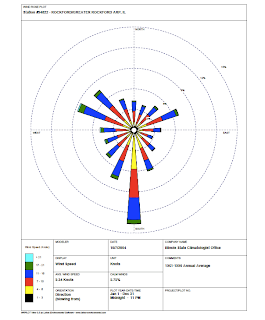
After takeoff or when you want to land you have to fly the pattern. This consists flying in a circle composed of roughly of four legs. Depending on the winds all traffic usually goes through the runway with a particular directional orientation. Poplar grove has two runways 27 and 30 for 270 and 300 degrees (orientation of the runway). Airport runways are laid out so that the most frequent winds are head-on to the runway. This is determined by a wind rose. Check it out, here is the wind rose for  One always wants to takeoff and and land into the wind, but cruise with a tailwind. 

This shows the strength and frequency of the winds on an annual basis, so it makes sense for airports to consult this when picking an orientation for the runways. Anyway you can google this for the details but basically the faster winds are toward the ends of the radials, and the larger the bar the more frequently the winds are out of that direction (a southernly wind means that its coming from the south, NOT heading south). 


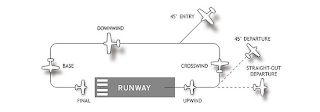
So back to the pattern- you takeoff into the headwind and turn left (normally most patterns are left turning, it is easier for the pilot to see when turning to the side that he's sitting on). After you turn left you are on the crosswind leg, then turn left again and you are parallel with the runway but heading downwind (meaning you have a tailwind). Next you make a left and this the base leg. If you make another left you've come full circle and are now on the approach leg heading upwind toward the runway. It is customary to enter the pattern on the downwind leg, and depart the pattern from the upwind. You have to enter the pattern at the proper altitude as well because you don't want to come in on top of someone, pattern altitude at Poplar Grove is a thousand feet above ground. Or 1,858 feet on the altimeter, because poplar grove is at an altitude of 858' above sea level. Announce you entry and final approach. 


Finally, there are different types of aviation gasoline (AVGAS). They are normally color coded by octane. You can go up in performance but never put a lower rated fuel into your engine because lower rated fuels combust at lower pressures and this could cause inefficient combustion and excessive engine heating. The C-172 takes 100LL (low lead). As of this entry, the cost of fuel is $3.85 a gallon, and we go through about 6 gallons during an hour of flight. 

Takeoff is cool, but for me I will not be happy until I can land the thing myself. Because from my current vantage point I can see that anyone can takeoff but landing is the proper closure, is more of an art and requires skill.  
 

5.27.2009

Can you feel the g's?


Let me ask you something. When is the last time you operated a car that was built in 1968? Would you depend on that 40 year old transmission to take you to where you need to go on a road trip? I guess I would have to now answer yes. Because in a similar way, I depended on the wings of a 40 year old Cessna 172 to not fall off in the middle of my first flight as a student pilot. My father, doubling as my flight instructor, saying "Oh they make planes much better than they make cars, don't worry." It was my first real lesson about flight. After you have done your pre-flight check and have diligently assessed the avionics, ailerons, and elevator trim and have lifted off the ground, it is of no real use to then start questioning the structural integrity of the aircraft. I confess that for the first half hour I was doing this. But eventually previous experience kicked in, and I decided to submit to the notion that those things were out of my control and no longer worried about the propellor snapping off. What a metaphor for life! 

Interesting thing about the propellors not working, we were at 5,000 feet level flight. My father reaches for the throttle and pulls it back (off), the propellor stops turning. I look at him and ask, why would you do that? It was the best way to prove to someone that if you lose power you wont just fall out of the sky (we had debated this fact earlier). Actually it was quite nice without the engine, we just sat there both staring forward, cruising quietly through the earth's gorgeous atmosphere, two descendants of the great apes in a metal box impersonating a bird thousands of feet above the ground sailing into the great blue yonder. So if it ever happens don't flip out. The glide ratio is how far you can get as you lose altitude. 20/1 glide ratio for perfect conditions in the 172 means that if I'm 5,280 ft (statute mile), I could technically get 20 miles for an emergency landing. However wind changes this dramatically. 80 knots is the glide speed that maxes out the glide ratio so adjust the yoke and trim accordingly, AFTER first completing the emergency checklist.

I noticed that it is better to be aware of heading, airspeed, weather, and most importantly where you are on the sectional chart! Because when you have to land, you not only have to remember in which direction the airport is, but you have to find it! 

The elevator trim is my friend and makes life much easier, it does away with the need of keeping constant force on the yoke. After setting a climb angle use it to set the yoke. 

I also learned to read the weather reports called METARs, meteorological report. Use this weather service
It will give you a report like this:

KRFD 272254Z 33008KT 8SM OVC008 14/13 A2971 RMK AO2 CIG 005V010 SLP058 T01440133

The first piece:

KRFD
K stands for contiguous United States, I have no idea why the K. RFD is the airport identifier (not code) We actually fly out of poplar grove airport C77, it is uncontrolled (no tower), but we use the Rockford forecasts.

272254Z
The date and time. 27 is the 27th of May at 22:54 zulu (Greenwich mean-time), minus five hours for CST during daylight savings, the time is 5:54 pm the time of the last update. 

33008KT
Winds. 0/360 degrees is north, 90 degrees is east, 180 is south, 270 is west. So here winds are out of 330 or 30 degrees West of North at 8 knots (nautical miles per hour). A nautical mile is 6,075 feet as opposed to 5,280 (statute mile). A nautical mile is one minute of latitude (the distance between north and south pole being 180 degrees). If one degree of latitude has 60 minutes or 60 nautical miles, what is the circumference of the earth?

8SM OVC008
Visibility is 8 statute miles or 8SM. Clouds are overcast at 800 feet or OVC008. If it were 8000 it would have been 080. 80,000 ft is represented as 800, just drop the last two zeroes. 

14/13 A2971
Temperature, dew point, and pressure. 14 degrees celsius, dew point 13 degrees. Set the altimeter to 29.71, thats inches of mercury, one atmosphere being 29.92 inches. As you can tell we are dealing with slightly high pressure. 

RMK AO2 CIG 005V010 SLP058 T01440133
Remarks - AO2 means automatic machine did the reading that can discriminate precipitation (AO1 can't).  CIG variable ceiling from 500 to 1,000 feet. SLP - sea level pressure 058, its in milibars or Pascals 1013.25mbar is one atm, 058 means you dropped the 1-0-1, so pressure is 1010.58. The last is measure is the exact temp and dew point - 14.40 degrees C, and 13.3 degrees C.

You can check the weather anywhere at anytime, it really is a modern marvel. Can you imagine how much riskier things were before this weather service? We are panzies compared to older times.
One time during a turn we banked at 45 degrees, it was a two g turn, it was pretty cool. He looked over and asked, "can you feel the g's?". I wanted to say, "maybe we should ask the wings..."
That was the first day.


On the second day, it was a bit windy. We drove out to the airport anyway, it was such a beautiful day, the only cloud cover was broken at 10,000 feet. The sun was glaring and bright. It was just a little too windy, 16 knots gusting to 21 knots. We called it, not today. We walked back to the car, I was staring at the sky. My father says to me, this is good that this happened, many times you will be tempted to ignore reasons that ground you. But remember, "it is better to be on the ground wishing you were in the sky, than in the sky wishing you were on the ground."  It was a good lesson.

Here is what medical school is like to me.


Here is a montage I made of things you learn in the first year of medical school. The are selected power point slides and lecture excerpts. I think its cute, please enjoy...

Oh its there trust me, cAMP is everywhere, you just can't see it.

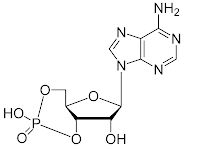
cAMP is a VERY important molecule. Here it is: 
This thing is arguably as important as ATP its more hot-headed relative - but look at the trans-phosphodiester bond between C3 and C4, that thing creates significant instability. And so we learned that cAMP binds PKA (protein kinase A) and other intracellular proteins activating them motivating them regulating them. If ATP is your rich uncle that pays for everything, cAMP is the unstable motivational speaker of the subcellular world, it binds inactive enzymes and "animates" them. If you are like me and drink coffee, you would care about all this because the psychostimulant caffeine inhibits phosphodiesterase, the enzyme that breaks the 4' phosphoester bond in cAMP. Thus caffeine indirectly raises cAMP inside the cell, something called disinhibition. 

Here is a new paper out this month.

There was no way to visualize intracellular cAMP for all of time until someone figured out how to show the molecule bound to PKA. The problem with this technique is that it is slow, takes forever, and cannot capture the momentary changes in cAMP that happen during normal physiology. Until now...

Epac is a cAMP exchange factor, like GAPs and GEFs. This is what they did. They took an adeno virus and added Epac-1 (protein holds cAMP), and also tagged it with YFP (yellow fluorescent protein). Then took specific parts of the brainstem known as pre-Botzinger complex neurons that are very sensitive to cAMP (the mediate respiration). They changed the cellular environment a whole bunch of time with different conditions and captured with on a microscope. 

Here is intracellular cAMP 


Here there is the medulla on slice! How nice! NTS - nucleus of the solitary tract, yup there is CNXII hypoglossal right where is should be. I love neuroanatomy. Pretty neat finding, I bet this will be a lab technique that gets a lot of use.


5.24.2009

L. Ron Hubbard

Went to the Scientology Church in times square Friday, they play the orientation film every 15 minutes.

                                                 Enjoy!

I have other things to do right now, but the analysis of this film is pretty straightforward-
establish credibility, reveal no dogma only technical and organizational details replete with jargon, overcome objections, promise guaranteed results, personal testimony from people like you and me (plus Kirstie Alley, Jon Travolta, and Isaac Hayes), and confrontational hard sell at the end. BUY our books- all to the backdrop of high romance cinematic soundscapes.

Pay careful attention to the placement of the actors, dressing and stereotyping, as well as the similarity with Christian imagery (cruciform symbol, church, etc...)  

I can see why this would work they're pretty good, and if you're lonely or suggestable you could be headed to the next org for an audit, not that its a bad thing - if it provides community and support, but  I cant comment on whether thats possible with Scientology... it is easy to be cynical about man made religions being for profit. Also - I love self help gurus, I think there enthusiasm is contagious, but it crosses the line at religion.

ps- i didn't film this

Cover Girl

I'm cooking breakfast and this commercial comes on. Its the latest cover girl commerical, and this time Ellen Degeneres is the model... she looks into the camera and says...
"inner beauty is important, but not nearly as important as outer beauty..."


Ellen, shame on you for selling out, you're whole career was built on the fact that you had very little outer beauty but your wit and humor prevailed. If outer beauty is so important, why don't you show us more of your body? Why are you in a black full pant suit in the commercial? Huh? If outer beauty is so important, lets see some legs honey... You were once a role model in full support of the notion that a women could be successful based on her intellect and observation (inner beauty) without having outer beauty, you were even on TV, an evironment notorious for selecting physical beauty.

What kind of message are you sending to all the girls and women in our culture that are already pathologically obsessed with their physical appearance? How much money did they give you?

5.14.2009

Idea

What about a children's book series on basic science laws - physics, biochem, cell? They would be very simple and colorfully illustrated and get across major themes in science - I would personify molecules and even try to interweave life lessons into the subcellular plot - e.g. - take ATP a neurotic type A, always doing something, phosphatases are classically depressed - hence blue, always shutting down cell function, just an idea - but the illustrations and visual representations (colors) would be far more important.

Personify but not anthropomorphize, no faces on the molecule, but suggest personality to,
or completely blend them - the nucleus is an infinitely repeating library, it would remind me of Borges Library of Babel
The nuclear transcription factors might be meek and silent librarians, keepers of the maze. It would be a fun project.

5.13.2009

Learning II


Eric Kandel gave the final lecture in our neuroscience course on the topic of learning and memory. In the lecture he described some molecular mechanisms behind the development of long term potentiation.


Here is a very important slide from the lecture. This slide depicts the current leading thought behind how long-term potentiation takes place (LTP). I remember that one time from my childhood, I remember my first plane ride, or the kid who bullied me all thanks to long term potentiation. LTP makes me who I am today. It is responsible for my conscious recall of facts, places, names, etc... Explicit memory. 

Quickly, in the bottom left corner a depolarizing excitatory stimulus activates NMDA receptors. Post synaptic intracellular calcium levels rise, and calcium dependent kinases are activated leading to increased levels of cAMP. The residual calcium makes the neuron more excitable for the time being, but in a short while the unbound intracellular calcium is either pumped out or sequestered, this is short term memory. But how do the big events get registered, the ones I will never forget, first kiss, first football season, first day of high school, college, work etc? Its not too different... Back in the neuron lets say instead of having all that calcium sequestered, the calcium containing neuron is repeatedly stimulated. Now the levels of calcium become so high that the levels of cAMP become elevated. Next in line in this molecular mousetrap is that protein kinase A which finally has the strength to fully dissociate from its regulatory subunit and remain activated. PKA in turn activates MAPK pathway, and the both of them make their merry way into the nucleus. Inside the nucleus (from Latin, nux, kernel, nut or inner part), cAMP response element binding protein or CREB for short is altered by these newly entered enzymes. CREB1 increases transcription and CREB2 decreases transcription of certain genes. CREB2 is silenced, CREB1 is freed and the initiation new protein synthesis can now occur. What are these new "memory" proteins?  New receptors, neuroligins, neurexins, etc... essentially things that make the connection between the two neurons more substantial. 


So Dr. Kandel brought up the interesting point that with new protein synthesis, there are physical changes in the brain when LTP occurs. If for some reason I remembered his talk, his words would have affected my memory, or ultimately the structure of my brain. Yes, the physical structure of my brain is altered, however insignificant, my brain would have weaker or stronger connectivities. Life has taught me that certain instances where my brain has been restructured have been more significant than others if you catch my drift.

Its interesting to speculate on the ramifications of his point because I believe personality is a very subtle and sensitive biological phenomenon. To the extent that aspects of my personality are learned, I have the responsibility to guard and culture my brain's connections in a responsible fashion. Which brings up another interesting point that was made in lecture. Here's another slide:


The slide proposes a mechanism for behavior disorders. I can not tell you how relieved I am that there is a molecular mechanism (pysch needs it badly, talk for another day). In the top row, labeled A, we have schizophrenia. Many are hard at work developing the pathogenesis of this disorder, there is a dopamine, serotonin, glutamate, and now a gene regulation hypothesis. Probably multifactorial, its a way to explain the behavior associated with this disorder. But take in row B there is normal behavior contrasted with that of a behavior associated with PTSD. This would be the first look into a molecular explanation of how a negative behavior is learned, reinforcing on a molecular scale. I'm just spitballing here, but it could be a justification for CBT. 

After lecture I had some questions, I asked:

What about CREB2 -/-?
How do you believe memory and creativity or intelligence overlap?
Why is learning in the critical period (time when a child where everything is easy) different than learning as an adult?

Answers:
CREB2 knockouts display quicker learning but reach a ceiling in their capacity. I gathered that there are too many other moving parts to look for a silver bullet. 

Memory does not map intelligence or creativity very well. He cited an anecdote of an artist who could not add six and six, yet was capable of creating stimulating visual art. I'm beginning to understand that intelligence, and most importantly creativity, is probably some sort of meta-cognitive function. I can't understand how I remember my name, so I'll save explaining why Chopin choose C# minor for another day. 

Learning language, music, mathematics, basically anything, is far easier as a child because the synaptic connections are looser, more susceptible to influence. What a double edged sword! 

Is there a way back? My belief is that there is, it just hasn't been found. The more I listen and learn the more it becomes apparent that we need to increase our appetite for risk. What a pleasure it is to learn of others labors and discoveries, but it is also wonderful to suppose what a breakthrough in that field could do for humanity. Research into subtle phenomena that make us human are poorly represented in animal models. In the name of science we decerebrate cats, inject poison into the veins of primates, and quite literally play God with the genome of mice. All for good reason I'm sure, but are we so much removed? Responsible but experimental and exploratory research should take place on willing and consenting humans. Our understanding of biology will necessitate a greater confrontation of the certain unavoidable truth that we are as much animal as human.